The average person doesn't exist. We stopped measuring them.
Entrelacs is built on a finding the field spent decades resisting: psychological instruments normed on populations systematically mismeasure individuals. Lacis, our proprietary engine, models one person at a time. That changes what measurement can do.
Why every survey you've taken was built for someone who isn't real.
4,063
pilots measured on ten dimensions
0
fit the average on all ten
In 1952, the U.S. Air Force measured 4,063 pilots on ten dimensions to design a cockpit for the average pilot. Zero pilots fit the average on all ten. The fix — the adjustable seat — established the first law of personalization: you don't fit the human to the mean, you build the instrument around the individual (Daniels, 1952; Rose, 2016).
Psychological measurement never had its adjustable seat. Engagement surveys, wellbeing questionnaires and most clinical scales still ask everyone the same questions and score answers against a population mean, carrying an assumption the measurement literature has formally rejected: that group-level statistics describe individuals (Molenaar, 2004). Two people with identical scores can be struggling for entirely different reasons. An average-based instrument can't tell them apart. And when a score drives a decision — a benefits allocation, a care pathway — mismeasurement compounds into real harm.
Our founding team spent two decades inside that problem as researchers, and helped produce the evidence that made it undeniable, including showing empirically that standard instruments don't measure the same construct across different people. Entrelacs is the instrument they built in response.

Lacis: person-specific measurement, engineered.
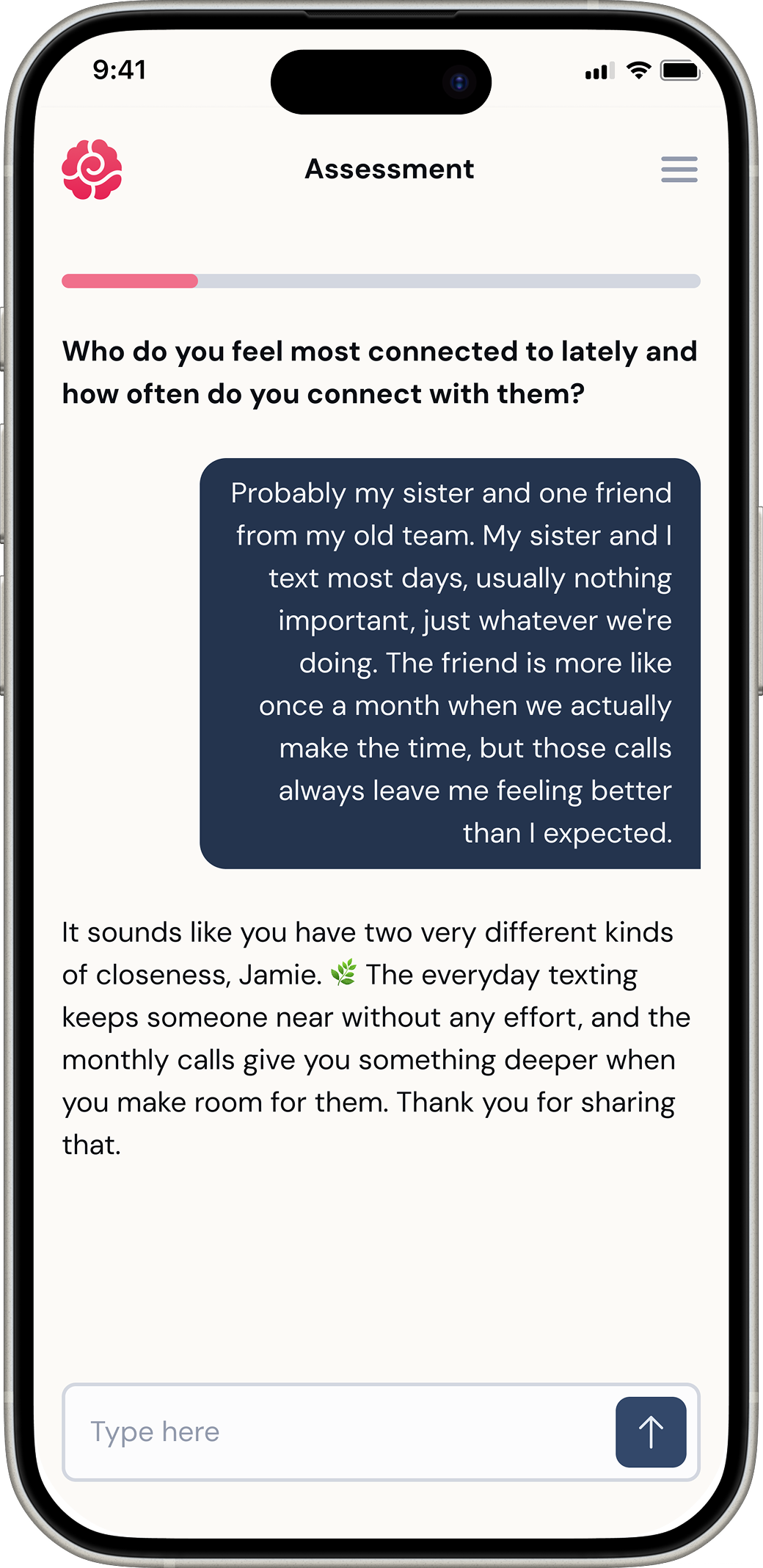
Tailored questions and a clear map of your connections to show you exactly what to change.
The four stages of the KSR (Key Signature Reconstruction) method — patent pending
Your subgroup, not the population
Before asking anything that matters, Lacis places you with people whose psychology moves the way yours does over time — a subgroup narrow enough that a conclusion drawn about the group is formally valid for the individual inside it. Population statistics assume this condition. They almost never meet it.
The most informative questions, for you
Once Lacis has your subgroup, it selects the questions that carry the most information for someone like you — not a fixed battery answered by everyone, but the smallest set of items that resolves uncertainty about your specific pattern fastest.
44-domain network modeling
Your answers are mapped into a network of 44 psychological domains, capturing how they relate to and reinforce one another for you specifically, rather than scoring each domain in isolation the way traditional instruments do.
Signature and keystone
From that network, Lacis extracts your signature — the handful of domains driving the rest — and your keystone, the single lever most likely to move the whole system if you act on it.
Why connection first
Brain capital cannot be tested directly at workforce scale; the test itself would become a performance exam. It can be measured through its determinants, and among them social connection carries the strongest evidence base at the lowest measurement burden. The same engine is built to extend to further determinants, including dimensions of depression and anxiety, on the same validation pipeline.
Why now
The components have precedents. Regulators have already certified conversational clinical assessment as a medical device in Europe, and payers already fund the detection of loneliness in covered populations. What no one had assembled is a person-specific instrument for the workforce — the position Entrelacs is built to occupy.
The measurement belongs to the person being measured.
A measurement instrument that people answer strategically is not measuring what it claims to. This is the failure mode legacy tools never solved: engagement surveys route answers to management, 42% of employees believe disclosure would damage their career (NAMI & Ipsos, 2025), and the resulting data is biased in a direction no statistical correction recovers. Entrelacs treats the trust architecture as part of the instrument.
The employee uses a private interface and gets results immediately: their own signature, keystone, and first move. Their answers, text, and data are encrypted and never shown to management or HR. The organization only sees patterns across groups of ten or more. Never who said what.
This isn't a privacy feature bolted onto a measurement product. It's the precondition for the measurement being true. People tell a mirror things they will not tell an employer.

What the AI does — and what it's forbidden to do.
Buyers are right to be wary of generative AI in mental health. The research is blunt: general-purpose models perform poorly at high-risk clinical tasks, tend to agree with users rather than assess them, and are almost never evaluated longitudinally.
Entrelacs is built against those failure modes. The large language model manages the conversation: it turns natural dialogue into structured inputs and explains results in plain, supportive language. As validated items move into conversational phrasing, each one passes psychometric-equivalence checks before it ships — response distributions, completion rates, and item functioning benchmarked against the original instrument.
It never scores, assesses or diagnoses.
All measurement, subgrouping, network estimation, and recommendation logic runs deterministically in Lacis — auditable, traceable, and grounded in a validated research corpus. The subgroup structure itself is learned offline from our research base, not invented in the moment by a generative model.
Entrelacs is not a therapy service and not a crisis service.
When a conversation surfaces acute distress, a signposting protocol governed by our Chief Clinical Officer directs the person to human help and crisis resources immediately. The instrument measures; people care for people.
Grounded in a research asset a competitor can't shortcut.
Lacis is calibrated on a research substrate built over five years by the Annecy Behavioral Science Lab (ABSL). The science is published and open; what Entrelacs licenses exclusively from ABSL is the personalized measurement method built on top of it. Its two longest-lead inputs are complete: a field-wide review screening 9,032 articles across seven languages, mapping every validated social-connection instrument in the literature; and a cross-cultural corpus of 354 in-depth interviews across eight countries and four continents, coded into the 44-domain model. Both took years. A competitor starts from zero on both — it cannot be reproduced by web-scraping or reading the same published literature, and it compounds with every deployment.
- ABSL’s work anchors the EU’s social-connection monitoring framework and informs the WHO’s development of a Global Index for Social Connection
- EU Horizon Europe - €3M LONELY-EU research project
- OECD cooperation on social health measurement
- Oxford University research affiliation
- Psychological Science Accelerator — research network spanning 80+ countries (our CSO is Associate Director)
- Strategic advisors at Stanford (Dr. Michal Kosinski — AI behavioral prediction) and UC Davis (Dr. Emorie Beck — personalized psychological measurement)
- Paris, B., Ropovik, I., Silan, M., d’Hombres, B., Casabianca, E., & IJzerman, H. (2026). Evaluating loneliness measurements across the European Union. Collabra: Psychology, 12(1).
- Coll-Planas, L., Akhter-Khan, S. C., Longworth, G., Srivastava, P., Mosalakanti, S., Silan, M. A., IJzerman, H., & McHugh Power, J. (2026). Rethinking loneliness interventions. — Why connection must be supported at the level of the individual, not the population.
- Silan, M. A. (2024). Rethinking multi-site studies in social and personality psychology. Social and Personality Psychology Compass. — The cross-cultural validity problem the 354-interview corpus was built to solve.
- Mosalakanti, S., Paris, B., Brickau, D., Luhmann, M., & Rocha IJzerman, H., (2026, August 25). A systematic review of social connection inventories.
- Molenaar, P. C. M. (2004). A manifesto on psychology as idiographic science: Bringing the person back into scientific psychology, this time forever. Measurement: Interdisciplinary Research and Perspectives, 2(4), 201–218.
- Borsboom, D. (2017). A network theory of mental disorders. World Psychiatry, 16(1), 5–13.
- Holt-Lunstad, J., Smith, T. B., Baker, M., Harris, T., & Stephenson, D. (2015). Loneliness and social isolation as risk factors for mortality: A meta-analytic review. Perspectives on Psychological Science, 10(2), 227–237.
- World Health Organization. (2025). From loneliness to social connection: Charting a path to healthier societies. Report of the WHO Commission on Social Connection. WHO.
- Office of the U.S. Surgeon General. (2023). Our epidemic of loneliness and isolation: The U.S. Surgeon General’s advisory on the healing effects of social connection and community. U.S. Department of Health and Human Services.







Engineered to clinical standards. Certified step by step.
Status today
A measurement and development instrument — deliberately not a diagnostic or treatment device, with clinical boundaries governed by our CCO and Clinical Advisory Board.
FDA (US)
Pre-Submission filed; pursuing De Novo classification (no clear predicate device exists — the route for novel instruments)
CE Mark (EU)
Class IIa, targeted 2027
Clinical governance
Clinical Advisory Board forming — six members across the US and France, at least half of them clinicians currently seeing patients; software development under ISO 13485/14971 discipline
Intellectual property
The KSR measurement method is patent-pending (U.S. provisional application filed June 2026)
Data protection
GDPR-compliant, encrypted infrastructure; EU data hosting for European deployments; multi-jurisdiction compliance program (EU, UK, Swiss, US including state privacy laws)
Care settings
HIPAA-aligned data handling
Security certification
SOC 2 Type II audit preparation in progress; ISO 27001 on the roadmap — security documentation available to procurement teams on request
Reporting threshold
Aggregation threshold of ten or more for any organizational reporting; voluntary participation with transparent, revocable consent, including for research use
If you need help now
Entrelacs is a measurement instrument, not a crisis service. If you need help now, it can only point you toward it.
If you're struggling, or worried about someone else, talk to a person — your doctor, a crisis line, or someone you trust. Your employer is not involved and cannot see that you looked.
- US — 988 Suicide & Crisis Lifeline, call or text 988
- France — 3114, national suicide prevention line
- UK — Samaritans, 116 123
- Elsewhere — findahelpline.com lists services by country
- Immediate danger — emergency services
If something in your report worried you, take it to a professional rather than sitting with it.

Start measuring the asset
everything else depends on.
Entrelacs is onboarding a limited design-partner cohort: organizations ready to deploy org-wide, on founding-partner terms.